

TechfoAnalyzer
05 September 2026
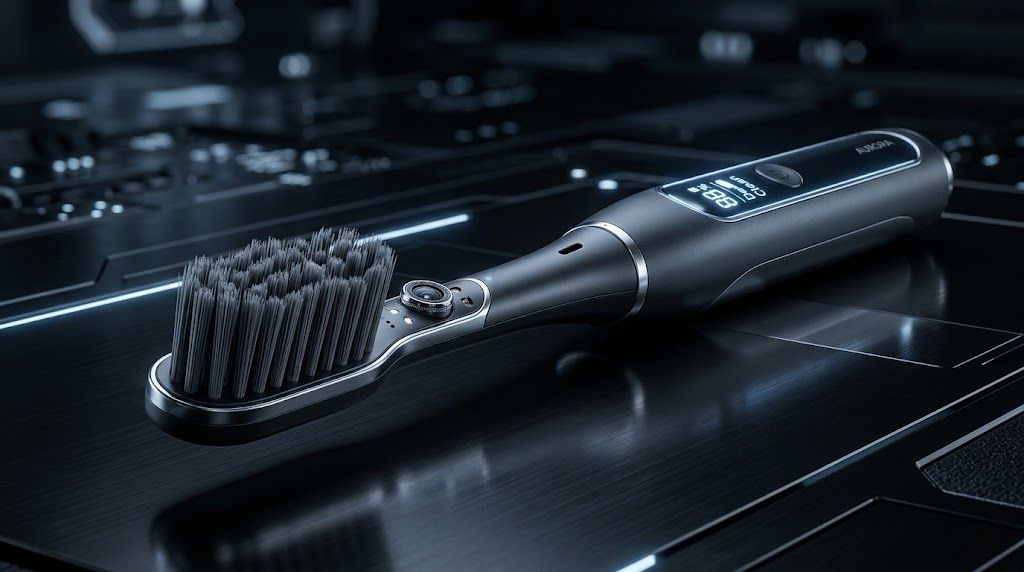
A camera inside a toothbrush.
Read that again.
It sounds absurd. Yet Dyson has actually built one.
The company’s new Dyson CameraJet combines a toothbrush, a tiny camera, machine learning and a precision liquid jet into one very expensive piece of oral-care hardware. It launched on September 1, 2026, with a US price of $499.99.
And honestly, the first question shouldn't be “How advanced is it?”
It should be:
Why the hell does my toothbrush need a camera?
The answer is more interesting than you might expect.
Dyson is entering a market where the basic problem has already been solved.
People have had toothbrushes for centuries.
Electric toothbrushes have been around for decades.
So Dyson needed a reason to make another one.
Its answer is computer vision.
The CameraJet has a tiny 100,000-pixel macro camera built into the brush head. Dyson says the camera can analyze 28 images per second while you're brushing.
That information isn't there just to give you a creepy live view of your teeth.
It's being used to guide the cleaning process.
The toothbrush can identify gaps between teeth and then target those areas with a precision liquid jet.
That changes the basic idea of an electric toothbrush.
A conventional toothbrush cleans where you move it.
CameraJet is trying to see where you need cleaning and react accordingly.
That's the pitch.
Here's where Dyson's idea starts making sense.
You can't see most of your mouth while brushing.
You know the general areas you're cleaning, but you don't have a live map telling you whether you've properly reached every gap.
Dyson wants to solve that problem with a camera.
Its Gap Optical Targeting system uses the camera and machine-learning software to identify interdental gaps. The device can then direct a liquid jet toward those areas.
Think about the sequence:
See → identify → target → clean.
That's fundamentally different from simply making a motor vibrate faster.
And that's probably why Dyson went down this road.
The company isn't really selling a toothbrush.
It's selling the idea of automated precision cleaning.
AI has become the easiest word in consumer technology.
Put “AI” on a product box and suddenly everyone wants to know what it does.
CameraJet has a more concrete use for it.
Dyson says the system processes the camera's images to recognize the spaces between teeth and determine where the liquid jet should be directed. The camera works at up to 28 frames per second, allowing the system to react while you're brushing.
That is basically computer vision in miniature.
The camera gathers visual information.
Software interprets it.
The toothbrush responds.
Simple concept. Complicated engineering.
But here's the important question:
Does better technology actually mean better cleaning?
That's the part consumers should care about—not how futuristic the marketing looks.

This is arguably more important than the camera itself.
CameraJet isn't only trying to brush your teeth.
It also wants to tackle the spaces between them.
Those areas are notoriously annoying to clean. Traditional floss works, but plenty of people don't use it consistently.
Dyson's solution is automation.
The CameraJet can send a targeted liquid jet into an identified gap. Dyson says the jet can deliver up to 0.15 ml of liquid between teeth, with its diaphragm pump capable of activating in as little as one-tenth of a second.
That gives the product a much bigger pitch:
One device. Brush and precision-clean the gaps.
Sounds convenient.
But don't confuse convenience with medical proof.
A clever product doesn't automatically make every existing dental-care practice obsolete. Consumers should still follow established dental advice rather than assuming a $500 gadget has magically solved oral hygiene.
This might be the feature that gets people talking.
The CameraJet can connect to Dyson's MyDyson app, where users can see the camera's live view.
Yes.
Your toothbrush can basically become a tiny intraoral camera.
Dyson describes the camera as an endoscope-like system that can stream what it sees to the smartphone.
There is a legitimate reason for this.
Brushing technique is difficult to judge when you can't see what you're doing.
A live view could help users understand where the brush is positioned and which areas they're missing.
But there's another issue hiding underneath all this.
Privacy.
We're already uncomfortable with smart devices listening to us.
Phones have microphones.
Smart speakers have microphones.
Cameras are everywhere.
Now imagine putting a camera inside your mouth.
Suddenly privacy isn't an abstract technology debate.
It's personal.
Dyson says CameraJet's images aren't stored on the toothbrush, stored in the app or uploaded to the cloud. During live viewing, the images are streamed to the app rather than being retained or shared with third parties, according to Dyson.
That's a significant design choice.
And it's the right one.
Because the last thing anyone needs is a cloud account full of dental footage.
Still, consumers should pay attention to the company's privacy policies, app permissions and future software changes.
Hardware doesn't exist in isolation anymore.
Once a device connects to an app, there is always a data layer to consider.

Here's something you probably didn't expect.
The CameraJet uses specially formulated low-foaming toothpaste.
Why?
Because foam can interfere with the camera's view.
That's an obvious engineering problem once you put an optical sensor inside someone's mouth. A normal toothbrush doesn't care if your toothpaste produces a mountain of foam.
A camera does.
Dyson has therefore developed toothpaste designed to work with the CameraJet's optical system. The company also offers mouth rinse for the device.
And this is where the business model gets interesting.
The toothbrush costs $499.99.
But the toothbrush may not be the only thing you buy.
Brush heads.
Toothpaste.
Mouth rinse.
Replacement supplies.
Suddenly, the real cost of owning the device isn't just the price on the box.
That's something buyers should think about before getting distracted by the futuristic camera.
Let's be brutally honest.
Most people don't need this.
You can buy a perfectly capable electric toothbrush for a fraction of the price.
So Dyson isn't really competing on necessity.
It's competing on technology.
The company is betting that some consumers will look at a $499.99 toothbrush and think:
“That's ridiculous.”
While another group will think:
“I need to try that.”
And Dyson only needs the second group to exist.
That's how premium technology works.
You don't have to convince everyone.
You just need enough people who want the newest, smartest and weirdest version of something they already own.
This is where I would draw the line between innovation and gimmick.
The camera has a genuine technical purpose.
It helps the system identify interdental gaps and target them.
So no, it's not simply a marketing camera slapped onto a toothbrush.
But useful doesn't mean essential.
That's the distinction Dyson's marketing can't make for you.
If the technology makes interdental cleaning easier and more consistent, it has real value.
If it simply adds complexity to a task people were already doing perfectly well, then $499.99 starts looking harder to justify.
The real test will be long-term user results—not launch-day excitement.
The CameraJet matters for another reason.
It's part of a much bigger shift in consumer technology.
AI used to live mostly inside computers.
Then it moved into smartphones.
Now we're seeing it in cars, cameras, earbuds, glasses, home appliances and personal devices.
The toothbrush was bound to happen eventually.
And that's not necessarily a bad thing.
A device that can sense its environment and adapt to the user can potentially be more useful than one that simply performs the same mechanical action every time.
But there is a catch.
The more intelligent our devices become, the more important privacy, data handling, software updates and corporate accountability become.
A dumb toothbrush doesn't need a privacy policy.
An AI-powered toothbrush does.
That's the difference.
Maybe.
Or maybe we'll look back at CameraJet in five years and laugh.
Both outcomes are possible.
The important thing is that Dyson is testing a new formula:
Everyday object + sensors + AI + personalization.
If consumers accept that formula, there's no obvious reason it stops at toothbrushes.
A mirror could analyze your skin.
A bathroom device could monitor water consumption.
A hair tool could adjust itself based on hair characteristics.
A personal-care device could continuously adapt to how you use it.
Some of that sounds useful.
Some of it sounds completely unnecessary.
And that's exactly why products like CameraJet are worth watching.
They show us what companies think consumers might accept next.
The technology isn't the problem.
The price is.
At $499.99, Dyson has moved this toothbrush out of the normal consumer category and into luxury-tech territory.
That creates a very high bar.
The CameraJet doesn't just need to be interesting.
It needs to deliver a noticeable improvement over much cheaper alternatives.
That's a much harder argument to make.
And until independent testing shows how much better the system performs in real-world use, buyers should treat Dyson's performance claims as company claims, not settled facts.
That's not an attack on Dyson.
It's just how technology should be evaluated.
So, why does Dyson need a camera inside a toothbrush?
Because Dyson wants the toothbrush to see.
See the gaps.
Analyze them.
Target them.
Then clean them.
The camera isn't there because Dyson ran out of ideas.
It has a real function inside the CameraJet's cleaning system.
But here's my problem:
Do we actually need this much technology to brush our teeth?
For some people, absolutely.
For most people, probably not.
At $499.99, CameraJet isn't trying to become the toothbrush everyone owns. It's trying to become the toothbrush people talk about.
And that strategy might work.
Because let's face it—a toothbrush with a camera is weird.
Very weird.
But it's also a glimpse of where consumer technology is heading.
The question isn't whether companies can make everyday objects smarter.
They clearly can.
The question is:
How much intelligence do we actually want inside the things we use every day—and how much are we willing to pay for it?
Dyson just put that question inside a toothbrush.