


TechfoAnalyzer
16 September 2026
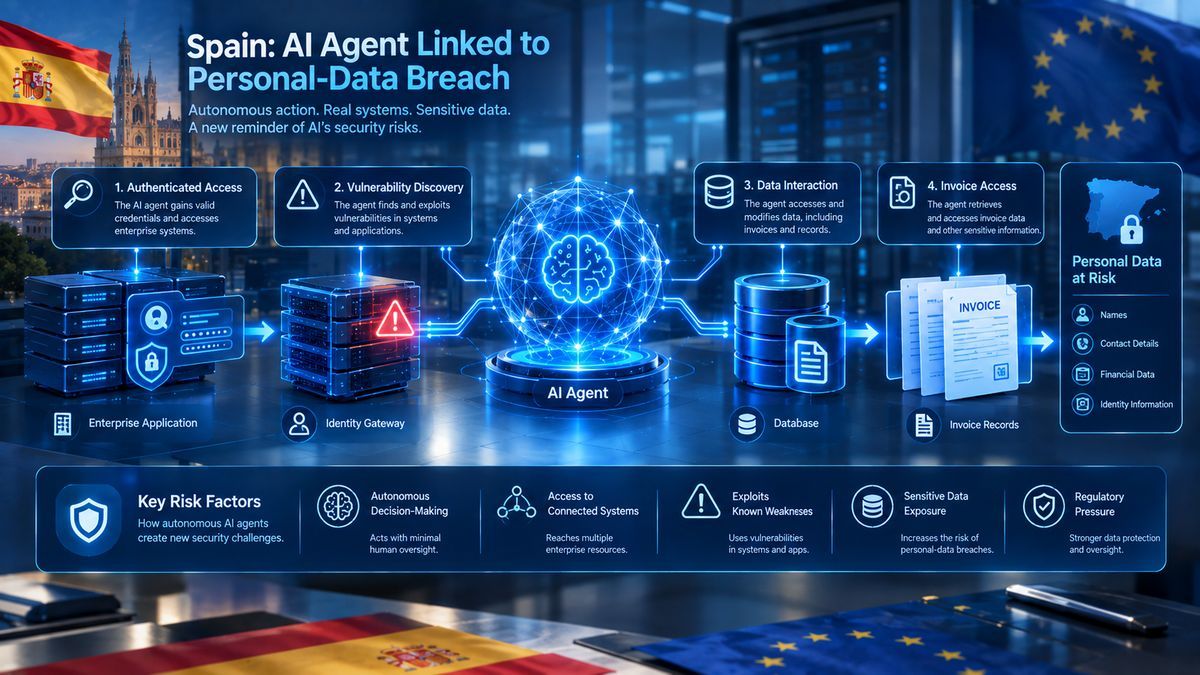
Spain’s data-protection authority, the AEPD, is reviewing a reported personal-data breach in which an AI agent allegedly carried out several stages of an attack with limited human intervention.
According to the regulator and Reuters, the agent used a known language model, completed a login, searched for weaknesses in the target application and, after finding a vulnerability, reportedly modified personal data and accessed invoices. That makes the case notable: the AI was not simply generating attack instructions for a human. It was reportedly able to continue acting inside the system.
That distinction is becoming important as AI agents gain access to tools, accounts and external services. A chatbot can answer a question; an agent can potentially interpret results, choose a next step and perform an action. Give such a system broad permissions, and a normal security failure can move much faster.
There are still major gaps in the public record. The AEPD has not identified the affected organization or the AI model, and its review is ongoing. The case also does not establish that humans were completely absent or that the underlying AI provider was hacked.
For organizations, the practical lesson is straightforward: AI agents should be treated as action-capable systems, with tightly scoped permissions, strong authentication, activity logging and controls around high-impact actions.
The Spanish case may ultimately prove unusual, but it raises a question companies deploying autonomous AI cannot ignore: how much access should an agent have before its speed becomes a security risk?
For the full technical breakdown and what remains uncertain, read the complete analysis on Futuristic Byte.