
TechfoAnalyzer
13 August 2026
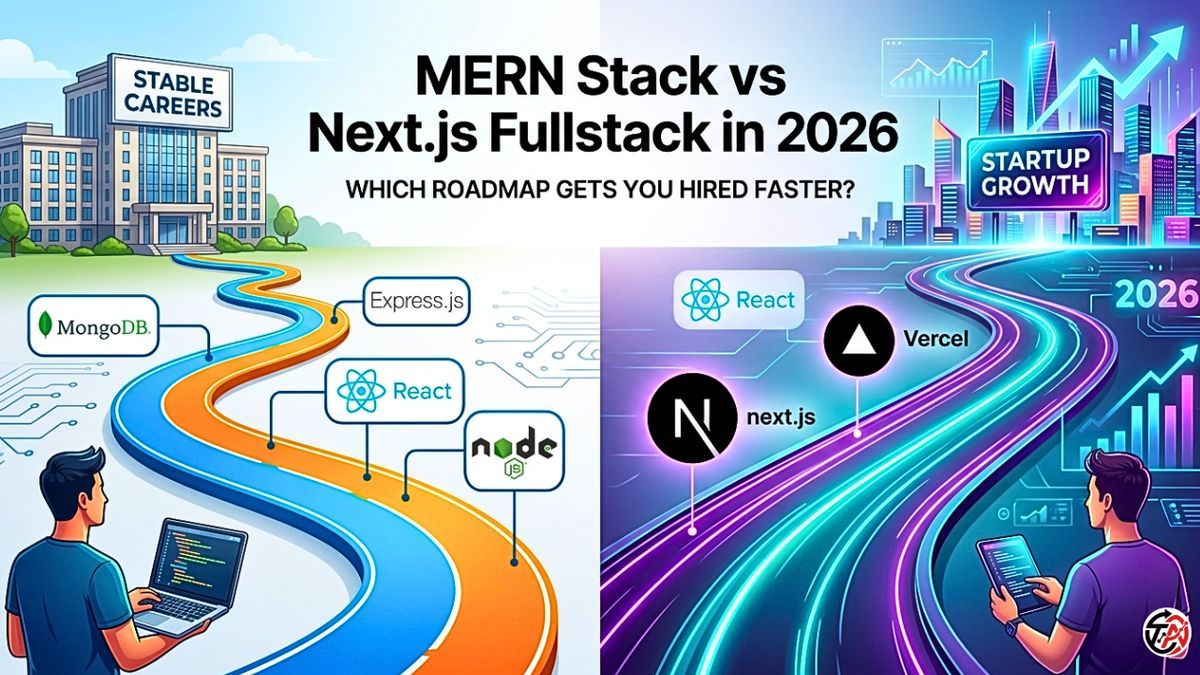
Let’s stop pretending all full-stack roadmaps are created equal. They aren’t.
If you’re breaking into web development right now, you're caught in a crossfire. Old-school bootcamps push an eight-month MERN setup—piecing together a decoupled React app, an Express server, and a MongoDB database. Meanwhile, tech influencers claim MERN is dead, insisting that if you aren't building exclusively in Next.js, you're practically obsolete.
So who's actually right?
Most beginners waste half a year building monolithic, unoptimizable client-side apps that no modern startup wants to hire for. Companies don't care about your theoretical appreciation for decoupled microservices—they care about shipping features yesterday, hitting performance benchmarks, and keeping server costs low.
Here is how the market actually works, why the traditional MERN pipeline is slowing you down, and the exact shortcut to getting hired fast.
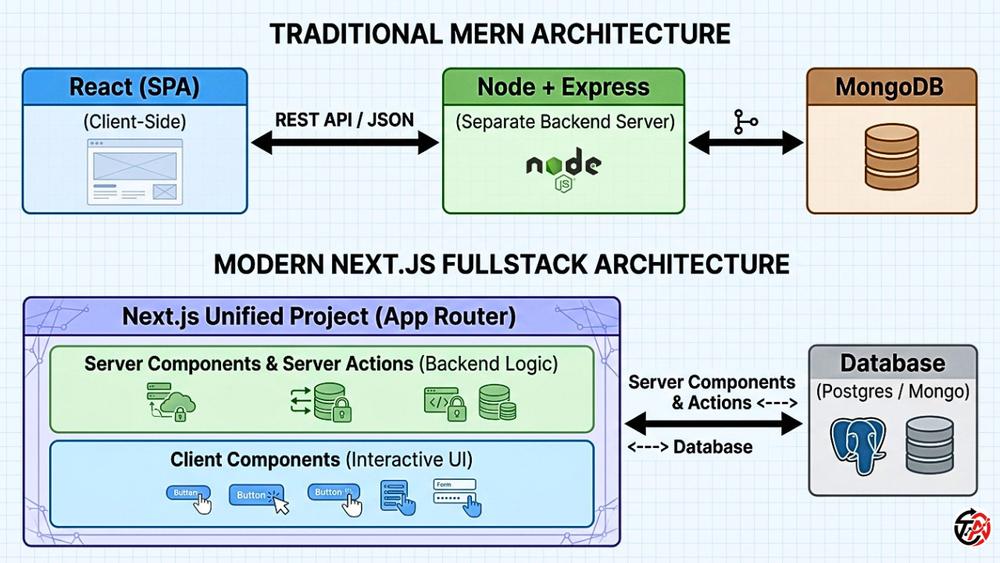
The MERN stack (MongoDB, Express.js, React, Node.js) forces you to split your project into two distinct worlds.
Client-Side Rendering (CSR)
React ships a giant, empty HTML shell to the browser alongside a heavy JavaScript bundle. The user’s device does all the heavy lifting.
Architecture Overhead
You maintain two codebases, two repositories, and two deployment pipelines. You spend hours writing boilerplate fetch() requests, setting up CORS policies, and managing JWT access tokens across domains.
Why People Love It
It forces you to explicitly see how an HTTP request moves from client to server and back again.
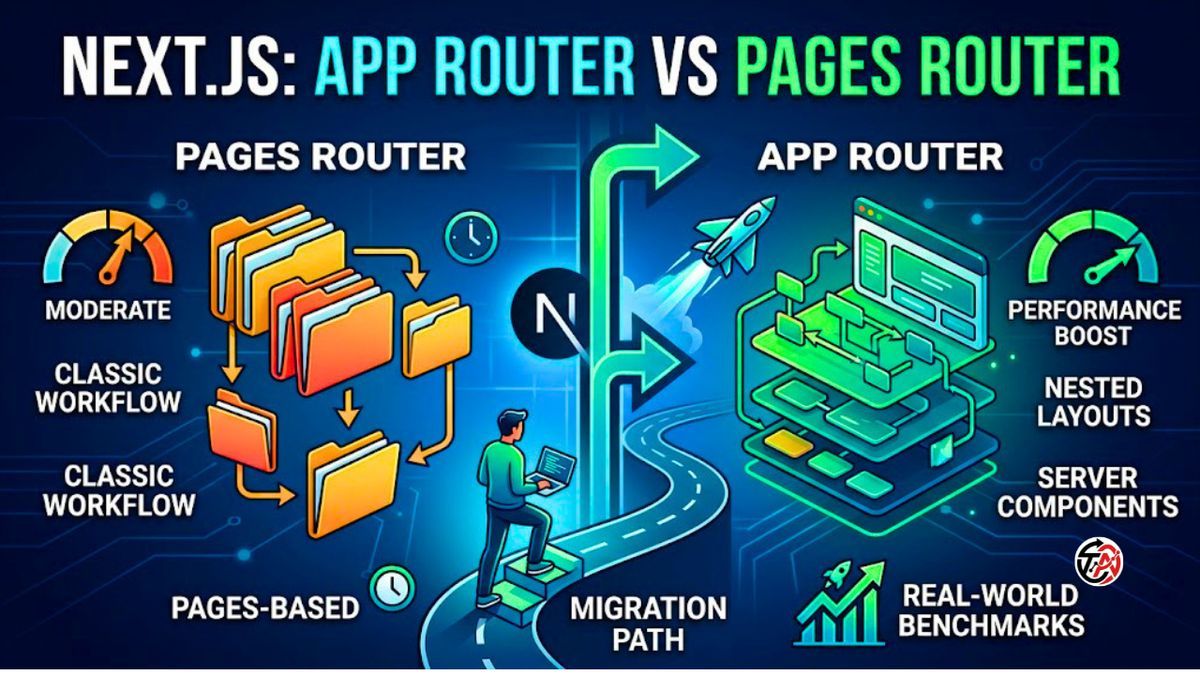
Next.js is an opinionated framework built on top of React that erases the line between frontend and backend.
App Router & Server Components
Code runs on the server by default. You fetch data directly from your database inside your React component—no public API endpoint required.
Server Actions
Forget about writing custom Express POST handlers and manual axios setup. You write an async function on the server and trigger it directly from your UI components.
Out-of-the-Box SSR & SSG
Next.js pre-renders pages into HTML on the server before sending them over the wire. Your site loads instantly, crawlers index every word, and search engines actually rank your pages.
Next.js does not eliminate Node.js or databases.
Next.js runs inside a Node.js engine. When you write a Server Action, you're still executing Node.js backend logic. Next.js simply removes the friction of building a separate Express application just to communicate with your React UI.
Startups rarely hire separate frontend and backend developers anymore. They want product engineers who can own features end-to-end.
A startup founder running on seed funding needs a live product this week—not next month. Next.js allows a single developer to design database models, write server logic, craft the UI, and deploy the entire platform to Vercel with a single Git commit. Show up with a split MERN app that requires two hosting providers and complex cross-origin setups, and you instantly look slow.
Big enterprise companies still use standalone Express or NestJS backends. Why? Because their API doesn't just serve a web app—it feeds iOS apps, Android apps, third-party vendor hooks, and internal microservices. If a company runs a dedicated multi-platform API, they won't tie their backend to a React framework.
Look at tech job boards today. You'll rarely see entry-level postings asking strictly for "Express.js Developers." Instead, "React / Next.js Engineer" is listed as a baseline expectation. Companies know client-side React alone produces sluggish, SEO-blind web applications. They expect you to understand Server-Side Rendering right out of the gate.
Full-stack Next.js engineers command a 10% to 15% salary premium over standard client-side React developers at entry and mid levels. You're directly impacting business metrics that executives track: page load speed, search engine rankings, and lower infrastructure overhead.
Timeline
6 to 8 Months
Pros
Deep exposure to raw HTTP headers, manual CORS configuration, and decoupled architecture.
Cons
Slow build execution. High setup fatigue. You spend months configuring infrastructure before building a product recruiters can actually interact with.
Timeline
4 to 6 Months
Pros
Rapid portfolio development. Single deployment setup. Native search engine optimization. You build production-grade, hirable SaaS products in half the time.
Cons
High risk of abstraction reliance—skip basic HTTP concepts, and you'll struggle during technical architecture interviews.
Don't treat MERN vs. Next.js as an all-or-nothing choice. The absolute fastest path to landing a job is a targeted three-phase strategy:
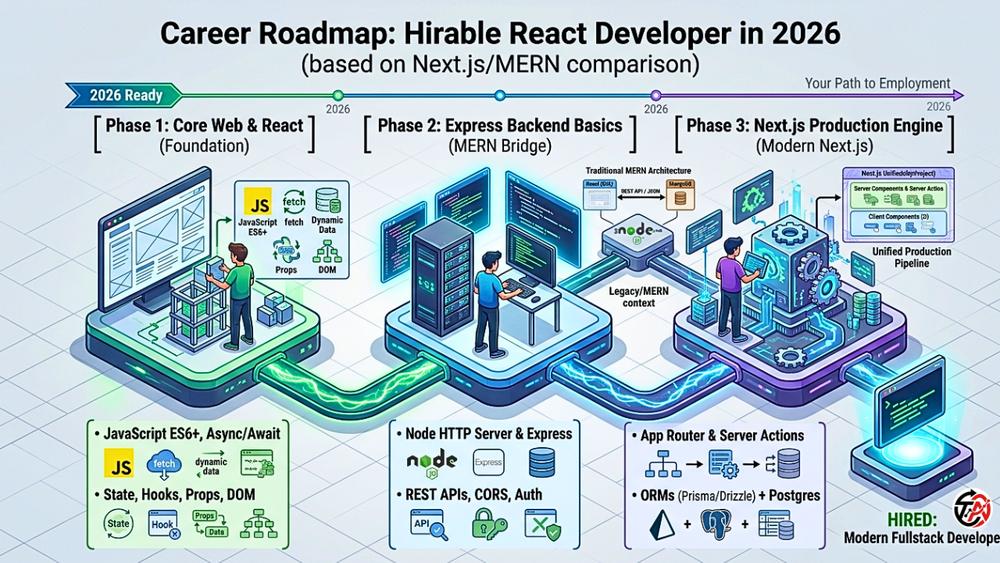
JS Mechanics
Master async/await, array methods (.map(), .filter()), ES modules, and closure scopes.
React Fundamentals
Focus on components, useState, useEffect, and component lifecycles. Master state management before reaching for external libraries.
Do NOT linger here. Build one simple Express server.
Learn how HTTP methods (GET, POST, PUT, DELETE) work, handle route parameters, configure CORS headers, and connect to a database. Once you understand how an Express controller receives a request and returns JSON, move on.
App Router
Master Server vs. Client Components ("use client"). Know exactly when to push work to the server and when to handle state on the client.
Server Actions & Data Fetching
Learn how to mutate database records directly from forms using Server Actions.
ORMs & Relational Databases
Move past basic Mongoose setups toward type-safe ORMs like Prisma or Drizzle paired with PostgreSQL (Supabase, Neon).
Production Auth
Skip custom JWT mechanics and integrate production tools like Clerk or Auth.js (NextAuth).
Recruiters spend seconds reviewing portfolios. See another tutorial clone? Rejected.
To-Do Apps or Weather Dashboards
They prove almost zero engineering depth.
UI Clones Without Real Backends
A slick frontend backed by hardcoded JSON shows you can mirror CSS—not build software.
Tech
Next.js App Router, Tailwind CSS, Prisma + PostgreSQL, Stripe API, Clerk Auth.
Features
Tiered subscription payments, usage tracking, real-time database updates, and protected dashboard routes. This proves you understand business logic, authorization, and secure transactions.
Tech
Next.js (SSR / ISR), PostgreSQL, Search Filters, Stripe.
Features
Server-side search filtering, session cart persistence, and top-tier load speeds (Lighthouse performance score > 90). This proves you can build fast, SEO-ready platforms that drive real user conversion.
| Metric / Scenario | Choose Traditional MERN If... | Choose Next.js Fullstack If... |
|---|---|---|
| Primary Goal | Building standalone microservices or dedicated mobile APIs. | Landing a full-stack product role at a modern tech company. |
| Application Needs | Internal admin tools where search engine rankings don't matter. | Commercial SaaS, marketplaces, e-commerce, or public web apps. |
| Development Speed | You have 8+ months to build and manage separate codebases. | You want a production-ready portfolio built in 4–5 months. |
Stop watching 40-hour tutorial playlists on loop.
Build one basic REST API in Express to learn how routing and database connections work under the hood.
Pivot straight to Next.js, Prisma, and PostgreSQL.
Build two full-stack applications featuring live payments and real authentication.
Ship them to custom domains, document your repos on GitHub, and start applying.