

TechfoAnalyzer
31 July 2026
AI didn’t just change software engineering—it exposed every developer who relied on copy-pasting CRUD templates. If you aren't building intelligent workflows, you're making your career obsolete.
Modern backend work isn't about moving JSON between databases and endpoints anymore. It’s about vector indices, latency optimization, agent orchestration, and hosting local models so companies can cut their cloud API bills.
Here is the exact, fluff-free roadmap to becoming an AI engineer in 2026.
Strip away the sci-fi media hype. What is AI in production? Code that trades rigid if/else rules for mathematical pattern matching.
Traditional engineering relies on explicit rules:
Input + Explicit Code ==> Output If a user hits an edge case you forgot to write a block for, the application crashes.
AI flips this paradigm:
Input + Target Data ==> Learned Rules (Model)You feed datasets to an algorithm, and it calculates the mathematical rules for you. In 2026, AI is the default engine powering real-time translation, automated document parsing, code generators, and self-healing infrastructure.
Cut through corporate pitch decks. AI is categorized by two things: Capabilities and Functionality.
┌─────────────────────────────────────────┐
					│    Artificial Intelligence Spectrum     │
                   	└────────────────────┬────────────────────┘
                               		     │
       ┌─────────────────────────────────┴─────────────────────────────────┐
       ▼                                                                   ▼
┌─────────────────┐                                                 ┌─────────────────┐
│ By Capabilities │                                                 │By Functionality │
└────────┬────────┘                                                 └────────┬────────┘
   		 ├─ Narrow AI (ANI)                                                  ├─ Reactive Machines
         ├─ General AI (AGI)                                                 ├─ Limited Memory
         └─ Super AI (ASI)                                                   ├─ Theory of Mind
└─ Self-AwarenessThe only form of AI that actually exists today. ANI handles specific tasks inside strict boundaries.
Examples
Code completion, fraud detection, vector engines, image models.
The Reality
Models like Claude or GPT-4 don't "think." They calculate token probabilities based on training data.
A theoretical machine that can learn, adapt, and reason across unrelated domains without retraining—matching human cognition.
Status
A distant benchmark hyped heavily by venture capital.
A theoretical state where machine cognition outperforms human intelligence in every measurable field.
Status
Pure theory.
The simplest form of AI. They process inputs immediately without saving context or state.
Classic Example
IBM’s Deep Blue. It evaluated chess boards in real time, but couldn't recall past matches to analyze a rival's playstyle.
Virtually every modern production model fits here. These systems keep temporary data buffers to update immediate decisions.
Classic Example
Autonomous cars monitoring surrounding vehicle speeds and trajectories to execute lane changes.
Machines that interpret human mental states, emotional context, and intentions.
Status
Early research.
Machines with actual self-awareness and internal sentiment.
Status
Sci-fi.
Stop using these terms interchangeably. They describe completely different layers of software engineering.
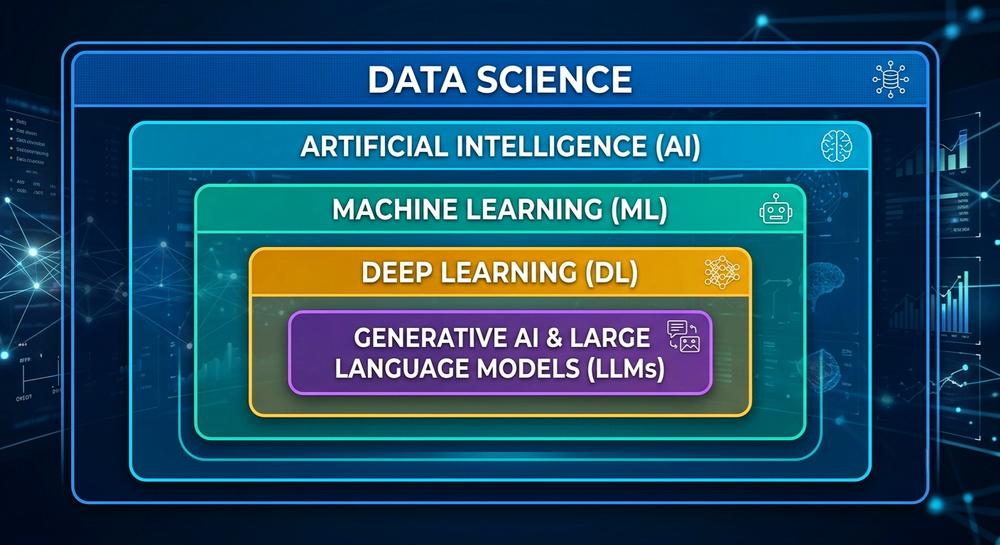
| Field | Primary Goal | Core Approach / Methods | Typical Deliverable |
|---|---|---|---|
| Data Science | Extracting operational trends from raw data. | Statistics, exploratory data analysis (EDA), SQL, data cleaning. | Dashboards, executive reports, predictive analytics. |
| Artificial Intelligence | Building software that makes automated decisions. | Rule engines, heuristics, probabilistic models, ML algorithms. | Automated engines, intelligent workflows. |
| Machine Learning | Training algorithms on data to learn patterns without manual rules. | Supervised learning, Unsupervised clustering, Reinforcement learning. | Exported model files (.pkl, .onnx), prediction APIs. |
| Deep Learning | Processing complex inputs like text or images using neural networks. | Deep artificial neural networks, CNNs, Transformers. | Computer vision systems, fine-tuned LLMs. |
Building apps today without understanding AI is like trying to write backend code without knowing how databases work.
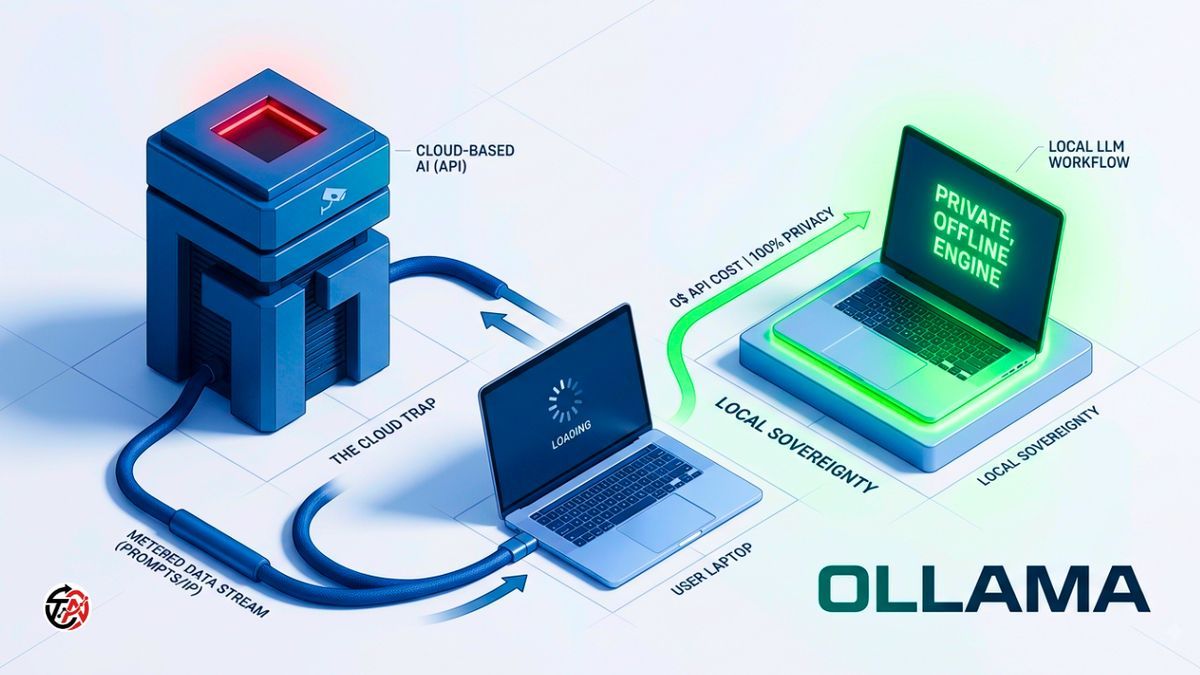
Relying entirely on third-party SaaS APIs is a margin killer. When your app scales, token costs explode—and you hand your data privacy keys to a vendor. Companies want developers who run local, open-source models (Llama, Qwen, Mistral) on private infrastructure.
With strict compliance rules like the EU AI Act penalizing cloud data leaks, knowing how to build private retrieval-augmented generation (RAG) pipelines makes you irreplaceable. Standard full-stack engineering is merging into AI engineering—if you can't index vectors, lower inference latency, and stop prompt injection, your skillset is expiring.
Ignore bootcamps selling multi-year degrees—and ignore influencers promising mastery in two weeks.
[Month 0] ──► [Month 3] ─────────────────► [Month 6] ──────────────────► [Month 9+]
    │             │                            │                            │
    ▼             ▼                            ▼                            ▼
  Setup      Fundamental            Applied AI Engineer           Production Specialist
    		 (Python, Math,         (APIs, RAG pipelines,         (Fine-tuning, Agents,
       		  Data Prep)             Vector Databases)             Scalable Deployment)
3 Months (AI Application Developer)
Integrate APIs, set up vector databases, build RAG pipelines, and wire up semantic search.
6 Months (Applied AI Engineer)
Master dataset prep, host local models using engines like Ollama or vLLM, build multi-agent workflows, and control execution costs.
9–12 Months (Specialized AI / MLOps Engineer)
Quantize models, fine-tune open-source models with LoRA/QLoRA on custom datasets, optimize GPU memory, and patch production security exploits.
Stop reading theoretical textbooks. Follow this battle-tested execution framework.
Do not skip basic engineering, or you’ll end up copying scripts you don't understand.
Python dominates this space. Master:
Core Mechanics
Data structures, object-oriented design, functional methods.
Environment Isolation
Stop messing up global environments. Use fast tools like uv.
Asynchronous Programming
Master asyncio. If your backend blocks while streaming tokens, your app won't scale.
You don't need academic proofs—you need practical intuition:
Linear Algebra
Vectors, matrices, dot products. Vectors are the literal language of embeddings.
Calculus
Derivatives and Gradient Descent—how neural networks calculate errors and update internal weights.
Statistics
Probability distributions, variance, and Bayes' theorem to measure model confidence.
Dirty data breaks good models. Master data prep:
Pandas & Polars
High-performance data cleaning and filtering.
NumPy
Vectorized numerical operations and array manipulation.
Break your learning into three progressive technical layers:
           ┌──────────────────────────────┐
                   		   │    Specialist AI Domains     │
                  		   └──────────────┬───────────────┘
                               	          │
        ┌─────────────────────────────────┼─────────────────────────────────┐
   		▼                                 ▼                                 ▼
┌──────────────┐                 ┌──────────────┐                 ┌──────────────┐
│ Classical ML │                 │ Deep Learning│                 │ Generative AI│
└──────┬───────┘                 └──────┬───────┘                 └──────┬───────┘
       ├─ Regression                    ├─ Neural Nets                   ├─ Transformers
       ├─ Decision Trees                ├─ CNNs & RNNs                   ├─ Embeddings & RAG
└─ Clustering └─ Loss Optimization └─ Agent FrameworksUnderstand core statistical algorithms first:
Supervised Learning
Linear/Logistic Regression, Decision Trees, Random Forests, XGBoost.
Unsupervised Learning
K-Means Clustering, Principal Component Analysis (PCA) for dimensional reduction.
Evaluation Metrics
Stop relying strictly on "Accuracy." Learn Precision, Recall, F1-Scores, ROC-AUC, and Mean Squared Error.
Neural Network Mechanics
Input layers, hidden activations (ReLU, Gelu), forward/backward propagation, and loss functions.
Specialized Networks
Convolutional Networks (CNNs) for vision, Recurrent Networks (RNNs/LSTMs) for sequential data.
Transformers
Understand Attention mechanisms (Self-Attention, Multi-Head Attention) and tokenization.
Vector Embeddings
Converting text, audio, and images into high-dimensional coordinate spaces.
Production RAG
Chunking strategies, semantic retrieval from vector stores, re-ranking inputs, and preventing hallucinations.
Fine-Tuning
Updating open-source model weights using Parameter-Efficient Fine-Tuning (PEFT), LoRA, and QLoRA on domain datasets.
You can't build production systems with vanilla Python standard libraries. Master the ecosystem tools that industry teams actually run.
┌────────────────────────────────────────────────────────────────────────┐
│                        Python AI Toolstack                             │
├─────────────────┬───────────────────┬────────────────┬─────────────────┤
│ Core ML & Math  │ Deep Learning     │ Vector DBs     │ Generative AI   │
├─────────────────┼───────────────────┼────────────────┼─────────────────┤
│ • NumPy         │ • PyTorch         │ • Qdrant       │ • LangChain     │
│ • Pandas        │ • Hugging Face    │ • ChromaDB     │ • LlamaIndex    │
│ • Scikit-Learn  │   Transformers    │ • Pinecone     │ • AutoGen /     │
│ • SciPy         │ • ONNX Runtime    │ • Milvus       │   CrewAI        │
└─────────────────┴───────────────────┴────────────────┴─────────────────┘
PyTorch
The primary industry framework for building, training, and running neural networks.
Hugging Face (transformers, peft)
The central registry for model weights, datasets, and execution scripts.
Scikit-Learn
The go-to library for classical machine learning, data transformations, and metric calculations.
Vector Databases (Qdrant, ChromaDB, Pinecone, Milvus)
High-throughput databases built to store, index, and search vector embeddings using similarity metrics.
Orchestration Frameworks (LangChain, LlamaIndex, AutoGen)
Libraries to manage prompts, handle long-term memory, and build multi-agent workflows.
Inference Engines (vLLM, Ollama, TGI)
Dedicated engines designed to run local models with high throughput and low latency.
A realistic, month-by-month framework to become a competent AI engineer over 10 months.
┌─────────────────────────────────────────────────────────────────────────┐
│                       10-Month AI Developer Plan                        │
└─────────────────────────────────────────────────────────────────────────┘
[Month 1-3]  ──► Python, Data Manipulation (Pandas), Scikit-Learn
[Month 4-6]  ──► PyTorch Basics, Embeddings, Vector DBs, RAG Architecture
[Month 7-9]  ──► Local LLMs (Ollama/vLLM), Autonomous Agent Frameworks
[Month 10+] ──► Fine-Tuning (LoRA), Model Deployment, Ethics & MonitoringGoal
Master Python, work with data libraries, and train classical machine learning models.
Execution
Learn advanced Python, object-oriented principles, and environment setup with uv.
Perform matrix manipulation and dataset processing with NumPy and Pandas.
Train supervised and unsupervised models using Scikit-Learn.
Master cross-validation, hyperparameter tuning, and metric evaluation.
Project
Build a real-estate price predictor or customer churn evaluator using Scikit-Learn. Expose predictions through an asynchronous FastAPI endpoint.
Goal
Understand neural network design, work with vector embeddings, and construct production RAG architectures.
Execution
Build foundational neural networks in PyTorch.
Load and test pre-trained weights via Hugging Face Transformers.
Store vector embeddings inside dedicated stores (Qdrant or ChromaDB).
Build a complete RAG system: Document parsing, text chunking, semantic retrieval, context re-ranking, and prompt assembly.
Project
Build a "Talk to Your Codebase / Docs" application. Parse local repos or PDFs, embed the data into a vector database, and build a local Q&A pipeline powered by a self-hosted LLM.
Goal
Move beyond single prompts. Construct multi-agent state machines that execute autonomous tasks.
Execution
Implement advanced prompting techniques: Few-shot, Chain-of-Thought (CoT), and ReAct patterns.
Build agent state machines using LangGraph, CrewAI, or AutoGen.
Equip agents with real tools: Direct SQL connections, web search hooks, code interpreters, and third-party APIs.
Manage state persistence, session history, and memory retrieval layers.
Project
Build an Automated Technical Vulnerability Auditor. Construct an agent team that scans raw code repositories, queries live CVE databases, writes a remediation plan in Markdown, and validates its own work before saving.
Goal
Fine-tune open-source models, host them on private hardware, and secure systems against vulnerabilities.
Execution
Fine-tune open-source models (Llama 3, Qwen 2.5) using LoRA and QLoRA on targeted datasets.
Deploy models using engines like vLLM or TGI on cloud GPUs.
Implement LLMOps: Track latency, monitor token burn rates, measure hallucination frequency, and trace bottlenecks using LangSmith or Phoenix.
Security & Compliance: Prevent prompt injection exploits, enforce output guardrails, and comply with data privacy laws.
Project
Fine-tune a lightweight open-source model on a custom enterprise dataset, deploy it on a cloud GPU instance with vLLM, protect it with API authentication and input guardrails, and monitor execution metrics on a live dashboard.
┌────────────────────────────────────────────────────────────────────────┐
│                        Key Principles for Success                      │
├────────────────────────────────────────────────────────────────────────┤
│ 1. Build Real Projects Early    ► Avoid tutorial hell; write real code │
│ 2. Master Local Toolchains      ► Learn to run open-source models      │
│ 3. Focus on Data Quality        ► Clean datasets outperform algorithms │
│ 4. Read Engineering Blogs       ► Follow production post-mortems       │
│ 5. Keep Security in Mind        ► Protect against prompt injections    │
└────────────────────────────────────────────────────────────────────────┘
Escape "Tutorial Hell" Immediately
Stop watching long video courses. Read the docs, pull down model weights, and write code—even if your first implementation is messy.
Master Local Execution
Don't rely blindly on third-party APIs. Learn to run and optimize open-source models locally using Ollama or vLLM. Understanding quantizations (GGUF, EXL2) and VRAM allocation is what separates actual AI engineers from basic API wrappers.
Data Quality Beats Hyperparameter Tuning
Garbage in, garbage out. A simple model fed pristine data will destroy a complex architecture fed noisy data every single time.
Read Real Production Post-Mortems
Stay sharp by reading engineering write-ups from teams running hardware at scale (Hugging Face, Cloudflare, LangChain, Pinecone). Learn how they handle memory leaks, GPU bottlenecks, and latency spikes.
Treat AI Inputs like Unsanitized SQL
Prompt injection is the modern equivalent of SQL injection. Never trust user input passed directly into an LLM context window—sanitize inputs and enforce strict execution guardrails on every single output.